A hygiene visit alone
If the staining is on the surface — and with Scottsdale water it very often is — scaling and polishing does more than any gel. We will suggest that first if that is what your photographs show.
New patients
A first visit is ninety minutes: full examination, periodontal chart, photographs, and a written plan before you leave.
Four display settings are kept in this browser. No analytics, no cookies. The room, the illuminant, your comfort settings and any palette you pick — nothing else, and no third-party scripts of any kind. Decline and it all still works; it just forgets when you close the tab. What is stored.
Treatment 04
Supervised peroxide whitening, in-office or in custom trays at home, with sensitivity managed rather than ignored.
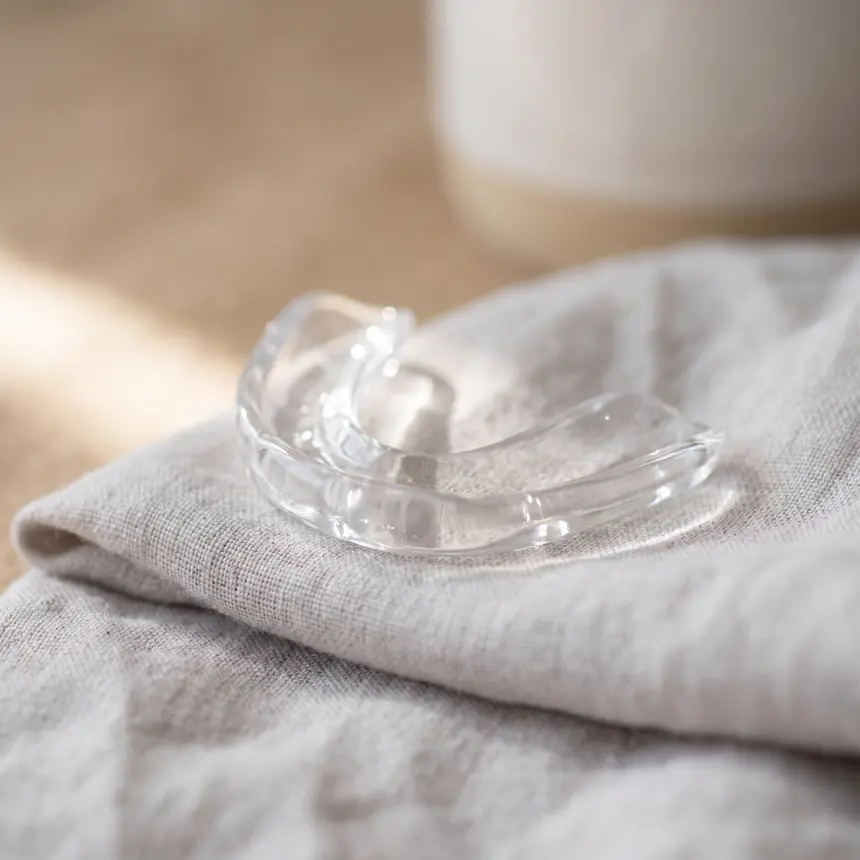
Whitening works by diffusing peroxide through enamel into dentine, where it breaks down the pigmented molecules that have accumulated there. It changes natural tooth structure only. Fillings, crowns, veneers and bonding do not lighten, which is why shade decisions have to come before restorative work, not after. In Arizona the usual culprits are coffee, red wine, sun-aged enamel and the mineral load in hard water, which leaves a surface film that a hygiene visit removes far more effectively than any gel.
The sequence
Whitening an untreated cavity is painful and pointless. We examine, take a shade record with photographs, and clean first — a hygiene visit alone lifts most surface staining from hard water and coffee.
Scanned and made to fit the gum margin precisely, so gel sits on the tooth and not on the gum. Ill-fitting stock trays are the main cause of chemical burns to the gum.
Carbamide peroxide overnight for ten to fourteen nights, or hydrogen peroxide for 30–60 minutes daily. We start at the lower concentration and step up only if you are comfortable.
A single 90-minute appointment with gum isolation and a higher-concentration gel, for people who want a head start before an event. Usually combined with home trays, because in-office alone rebounds.
Shade re-recorded against the original photograph. Most people top up for two or three nights once or twice a year.
Instead of this
A cosmetic practice that never names the less profitable option is not giving you a choice.
If the staining is on the surface — and with Scottsdale water it very often is — scaling and polishing does more than any gel. We will suggest that first if that is what your photographs show.
For a single dark root-treated tooth, whitening gel is sealed inside the tooth for several days. Far more effective on that one tooth than any external product.
Where the discolouration is intrinsic — tetracycline banding, severe fluorosis — whitening will only partly help, and a bonded restoration is the honest route.
Before you agree
This is the part most sites leave out. It is also the part that a consent discussion is legally and ethically built on.
Fee
Home whitening with custom trays. In-office session $650. Combined $850. Top-up gel $35 per syringe. Members receive one top-up syringe a year at no cost.
Indicative. Your written plan is itemised and is produced only after an examination. Members take 15% off restorative fees. We are out of network; you receive a coded receipt for out-of-network reimbursement.
A word on language. You will not read the word “painless” on this site, and you will not read that any restoration is permanent. Local anaesthetic makes most treatment comfortable at the time; some procedures are sore afterwards and we will tell you which and for how long. Restorations are maintainable, not eternal. Anyone promising otherwise is selling rather than consenting.
Questions
Supervised peroxide whitening at clinical concentrations has been studied extensively and is not shown to soften enamel in a clinically meaningful way. What does cause damage is uncontrolled acidic products, abrasive charcoal pastes, and gels applied over untreated decay.
Starting shade, dentine thickness and the type of pigment all differ. Grey-toned discolouration responds less well than yellow-toned. We show you your own before-and-after photographs against a shade tab rather than compare you to anyone else.
Typically one to three years before most people want a top-up, and less if you drink a lot of coffee or red wine. Keeping your trays means a top-up costs the price of a syringe of gel.
No. Ceramic and composite do not change colour. If a front crown is already a good match, whitening the teeth around it will leave it looking dark, and it may need replacing — we will flag that before you start.
Related
$190, credited against treatment. Scottsdale, Arizona.
Six palettes. Each one is guarded in both rooms.
A palette repaints every branded surface — header, footer, buttons, links, focus rings, gradients, icons and the scatter field — in both the light and the dark room. It never repaints the regulated notices; those keep their own printed ground on purpose.
Type, practice name, phone, email and logo are the build's own machinery rather than a visitor's choice, so they are not in here. They live behind ?studio=1.
Four controls that actually do something.
These are real settings, not a badge. This site has not been independently audited against WCAG and does not claim conformance to it.