Fixed appliances
Brackets and wire. More control, no compliance requirement, and often faster for complex movement. We refer to a specialist orthodontist for these cases rather than compromise the plan.
New patients
A first visit is ninety minutes: full examination, periodontal chart, photographs, and a written plan before you leave.
Four display settings are kept in this browser. No analytics, no cookies. The room, the illuminant, your comfort settings and any palette you pick — nothing else, and no third-party scripts of any kind. Decline and it all still works; it just forgets when you close the tab. What is stored.
Treatment 02
Removable clear trays that move teeth in small increments — and an honest account of when fixed braces are simply better.
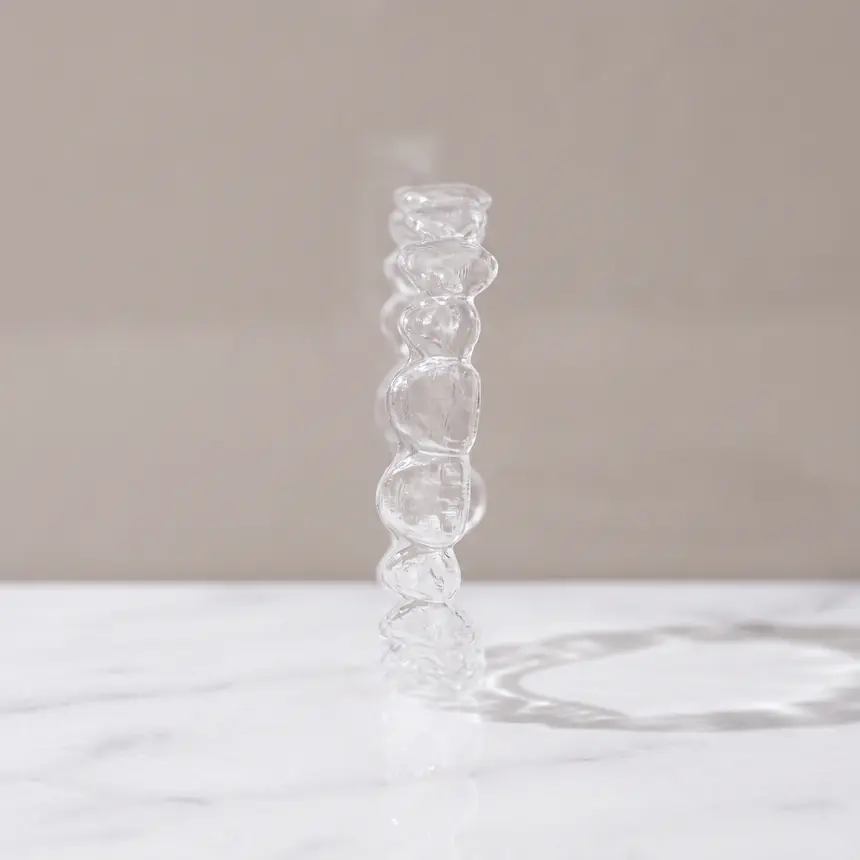
Clear aligners move teeth by applying light, continuous force through a series of trays, each one shaped slightly differently to the last. They are excellent at rotations, spacing, mild crowding and levelling. They are weaker at large vertical movements, closing extraction spaces and correcting significant skeletal discrepancies — those are jobs fixed appliances still do better, and we will tell you when that is the case rather than sell you the treatment you asked for.
The sequence
A digital scan, photographs and a panoramic radiograph. We check gum health and root length before planning any movement — teeth with periodontal bone loss can be moved, but the plan changes.
You see the proposed movement stage by stage before committing, including where attachments will sit and whether any interproximal reduction is needed to make room.
Small tooth-coloured attachments are bonded where the trays need something to grip. The first trays are fitted and you are shown how to seat and remove them.
Every six to eight weeks. We check the trays are tracking; if a tooth is lagging we intervene early rather than at the end.
Teeth drift for life. A bonded wire behind the front teeth, a removable retainer at night, or both. Retention is not optional and it does not stop.
Instead of this
A cosmetic practice that never names the less profitable option is not giving you a choice.
Brackets and wire. More control, no compliance requirement, and often faster for complex movement. We refer to a specialist orthodontist for these cases rather than compromise the plan.
Where only the front six teeth need work and the bite is stable, a short course of four to six months can be enough. Cheaper, faster, and it does not pretend to fix the back teeth.
Mild crowding that is stable and cleanable is a legitimate thing to leave alone. We would rather say that than start a case for the sake of it.
Before you agree
This is the part most sites leave out. It is also the part that a consent discussion is legally and ethically built on.
Fee
Full course. Includes records, the digital plan, all trays, one refinement round, all reviews and a first set of retainers. Limited anterior cases start at $2,900.
Indicative. Your written plan is itemised and is produced only after an examination. Members take 15% off restorative fees. We are out of network; you receive a coded receipt for out-of-network reimbursement.
A word on language. You will not read the word “painless” on this site, and you will not read that any restoration is permanent. Local anaesthetic makes most treatment comfortable at the time; some procedures are sore afterwards and we will tell you which and for how long. Restorations are maintainable, not eternal. Anyone promising otherwise is selling rather than consenting.
Questions
Nobody examines you, nobody takes a radiograph, and nobody checks whether the roots and bone can take the movement being planned. Aligners applied to a periodontally compromised mouth can do real damage. Every case here begins with an examination and imaging.
No. Trays come out to eat and to drink anything except water, then go straight back in. Most of the wear-time failures we see are people leaving them out through long meals and coffee.
They will if you stop retaining. Teeth move throughout life whether or not you have had orthodontics. Long-term retention is part of the treatment, and we plan it from the start.
Sometimes. Aligners can manage some bite correction, but deep bites, open bites and significant jaw relationships are limited by what a removable appliance can do. If your case is one of those, we will say so at the consultation and refer you.
Related
$190, credited against treatment. Scottsdale, Arizona.
Six palettes. Each one is guarded in both rooms.
A palette repaints every branded surface — header, footer, buttons, links, focus rings, gradients, icons and the scatter field — in both the light and the dark room. It never repaints the regulated notices; those keep their own printed ground on purpose.
Type, practice name, phone, email and logo are the build's own machinery rather than a visitor's choice, so they are not in here. They live behind ?studio=1.
Four controls that actually do something.
These are real settings, not a badge. This site has not been independently audited against WCAG and does not claim conformance to it.