Referral to a periodontist
Deep sites that do not respond to non-surgical therapy, and cases with significant bone loss, are better served by a specialist. We refer rather than repeat treatment that is not working.
New patients
A first visit is ninety minutes: full examination, periodontal chart, photographs, and a written plan before you leave.
Four display settings are kept in this browser. No analytics, no cookies. The room, the illuminant, your comfort settings and any palette you pick — nothing else, and no third-party scripts of any kind. Decline and it all still works; it just forgets when you close the tab. What is stored.
Treatment 05
Full periodontal charting, scaling and root planing where it is indicated, and a maintenance interval set by your risk rather than a calendar.
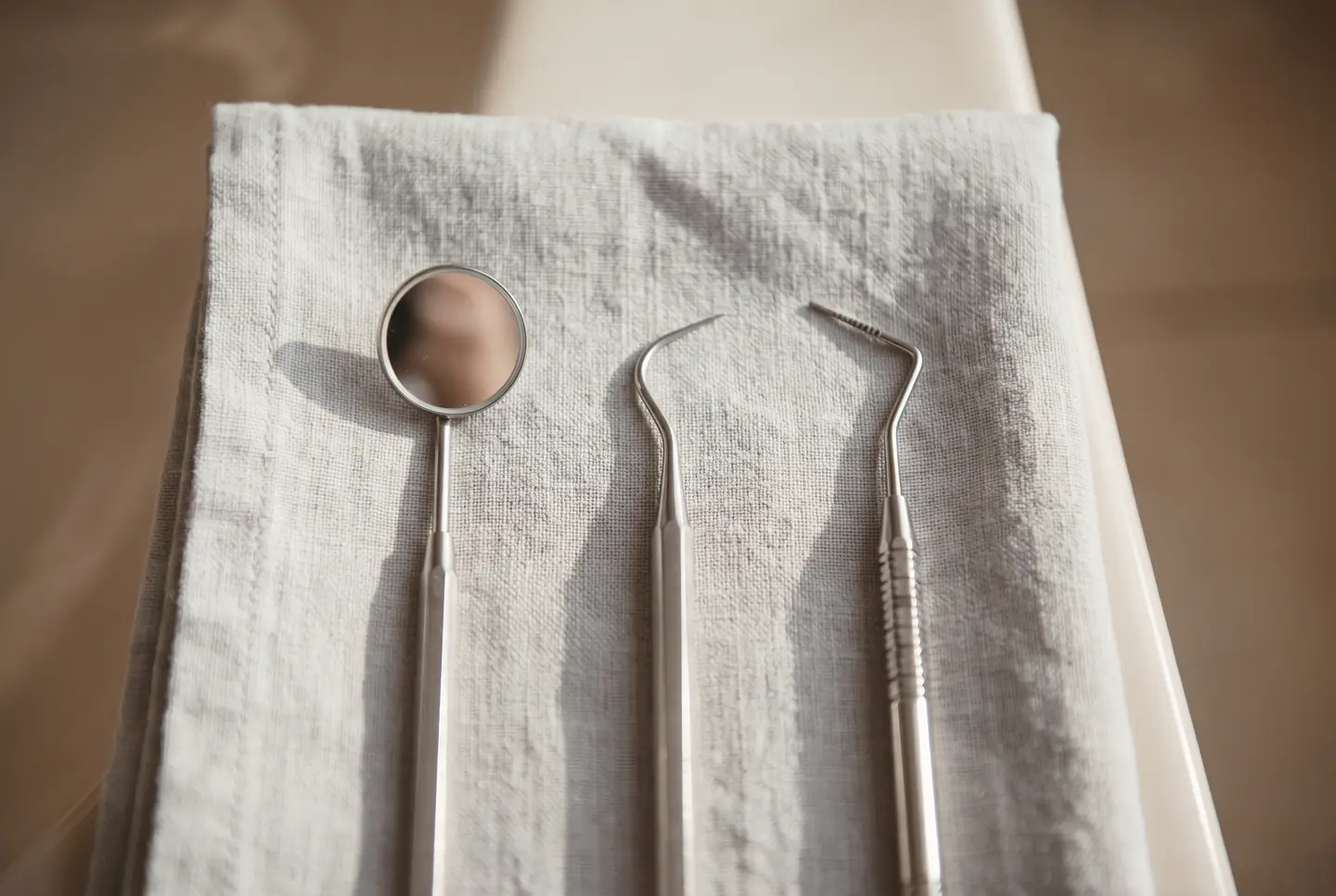
Periodontal disease is the reason most adults lose teeth, and it is close to silent until it is advanced. We chart it properly: six measurements per tooth, bleeding points, recession, mobility and furcation involvement, recorded so that this year can be compared with last year. A number on a chart is the only way to tell whether a mouth is stable or slowly losing attachment, and it is the basis for everything else we plan — including whether a mouth is ready for veneers or implants at all.
The sequence
Six pocket depths per tooth, bleeding on probing, recession, mobility. Radiographs as indicated. This is the baseline everything is measured against.
We explain what the numbers mean in plain language: which sites are stable, which are active, and what the realistic outcome of treatment is for each.
Where pockets exceed 4 mm and bleed, deposits are removed from the root surface below the gum, under local anaesthetic, usually across two appointments by quadrant or half-mouth.
Re-charted six to eight weeks later. Sites that have responded go onto maintenance; sites that have not are considered for referral to a periodontist.
Three, four or six months, set by your measured risk rather than a default. Most stable patients settle at six; treated periodontitis usually needs three or four.
Instead of this
A cosmetic practice that never names the less profitable option is not giving you a choice.
Deep sites that do not respond to non-surgical therapy, and cases with significant bone loss, are better served by a specialist. We refer rather than repeat treatment that is not working.
For a genuinely healthy mouth with no pockets over 3 mm, a routine hygiene visit is the whole of the treatment and costs a fraction of a periodontal course.
Before you agree
This is the part most sites leave out. It is also the part that a consent discussion is legally and ethically built on.
Fee
Hygiene visit. Full periodontal charting $95. Scaling and root planing $310 per quadrant. Members: two hygiene visits and all charting included.
Indicative. Your written plan is itemised and is produced only after an examination. Members take 15% off restorative fees. We are out of network; you receive a coded receipt for out-of-network reimbursement.
A word on language. You will not read the word “painless” on this site, and you will not read that any restoration is permanent. Local anaesthetic makes most treatment comfortable at the time; some procedures are sore afterwards and we will tell you which and for how long. Restorations are maintainable, not eternal. Anyone promising otherwise is selling rather than consenting.
Questions
No. Healthy gums do not bleed when they are cleaned properly. Bleeding is the earliest sign of inflammation and it is the one sign patients can see themselves. It is also the stage at which the condition is most reversible.
Because a single set of numbers tells you almost nothing. The comparison between this year and last is what shows whether a mouth is stable, and it is what decides your recall interval.
It contributes to surface staining and to visible mineral deposits, and it makes calculus more obvious. It does not cause gum disease — bacterial plaque does — but it does mean that many people here see a bigger visible improvement from a hygiene visit than from whitening.
Whatever your risk says. Six months is a convention, not a clinical finding. Treated periodontitis usually needs three or four months to stay stable; a low-risk mouth can be fine at six or even longer.
Related
$190, credited against treatment. Scottsdale, Arizona.
Six palettes. Each one is guarded in both rooms.
A palette repaints every branded surface — header, footer, buttons, links, focus rings, gradients, icons and the scatter field — in both the light and the dark room. It never repaints the regulated notices; those keep their own printed ground on purpose.
Type, practice name, phone, email and logo are the build's own machinery rather than a visitor's choice, so they are not in here. They live behind ?studio=1.
Four controls that actually do something.
These are real settings, not a badge. This site has not been independently audited against WCAG and does not claim conformance to it.