Enamel.

Treatment 03

Dental implants

A titanium root placed in bone to carry a single crown or a bridge, with a healing period the biology decides.

3–9 months depending on graftingSingle tooth, start to finish: $4,600 — $6,200
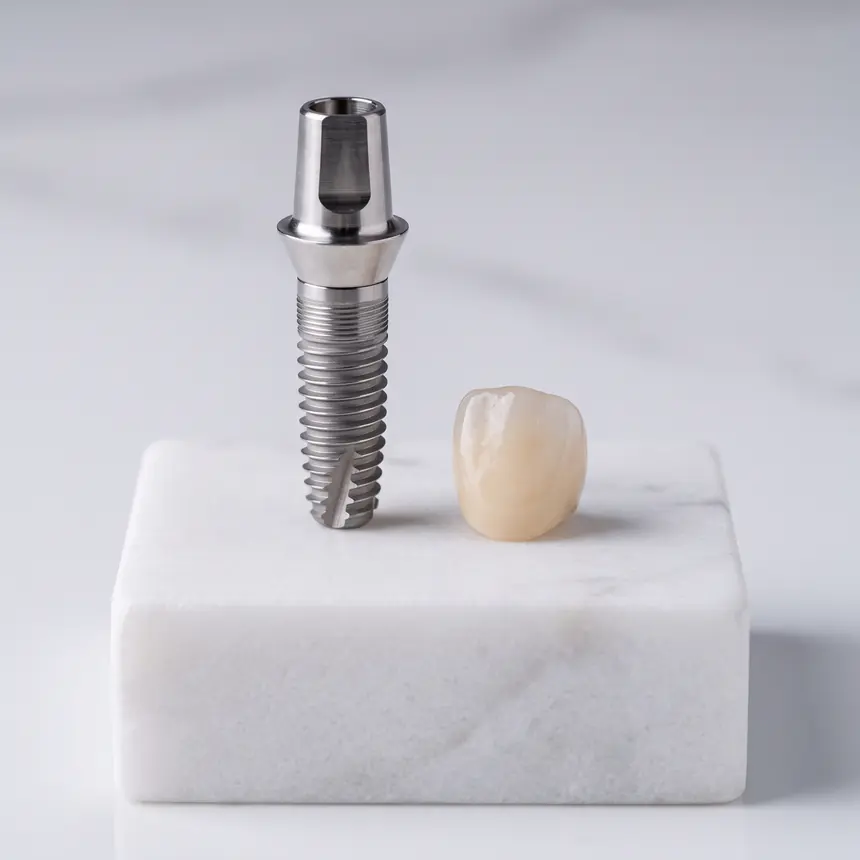
A titanium implant fixture and abutment beside a ceramic crown on white marble

What it actually is

An implant is a threaded titanium fixture placed into the jaw, which the bone then grows onto over several months. That process — osseointegration — is biology, not carpentry, and it sets the timetable. Once integrated, the fixture carries a crown, a bridge or a denture attachment. Implants do not decay, but the gum and bone around them can become inflamed and lose attachment in much the same way as around a tooth, so maintenance matters more than most people are told.

The sequence

6 stages, in this order, for this reason.

  1. 01

    Assessment and CBCT

    A cone beam CT scan shows bone volume, density and the position of the nerve and sinus in three dimensions. We plan the fixture position digitally against the crown we intend to make, not the other way around.

    Visit one · 60 minutes
  2. 02

    Grafting, if it is needed

    Where the ridge has resorbed, bone graft material is placed to rebuild volume. Healing before the fixture goes in is typically four to six months for a socket graft, longer for a sinus lift.

    When indicated · 4–9 months healing
  3. 03

    Fixture placement

    Placed under local anaesthetic, usually through a surgical guide printed from the plan. Most people describe pressure rather than pain. Expect some swelling for two to three days.

    Surgical visit · 60–90 minutes
  4. 04

    Integration

    Three to four months in the lower jaw, four to six in the upper, longer over a graft. A temporary tooth bridges the gap where the site is visible.

    3–6 months
  5. 05

    Restoration

    A scan of the integrated fixture, then a custom abutment and crown. The bite is set so the implant carries slightly less load than the teeth either side.

    Two visits · 3 weeks apart
  6. 06

    Maintenance

    Reviewed at six months, then annually with radiographs. Implants need a different cleaning technique and a different instrument set from teeth.

    Ongoing

Who it suits

  • A single missing tooth where the neighbours are healthy and untouched
  • Several missing teeth where a removable partial denture is unwelcome
  • Securing a lower denture that will not stay put
  • People who do not smoke, or who will stop for the healing period

When we would say no

  • Active periodontal disease — the same bacteria affect implants, and it must be controlled first
  • Heavy smoking, which measurably raises the failure and peri-implantitis rate
  • Uncontrolled diabetes or current high-dose antiresorptive therapy, without medical liaison
  • Growing patients, where the jaw is still developing

Instead of this

The alternatives, including the cheaper ones.

A cosmetic practice that never names the less profitable option is not giving you a choice.

A conventional bridge

Faster — weeks rather than months — and no surgery. The cost is preparing the two neighbouring teeth, which may be perfectly healthy. Where they already carry large fillings, a bridge can be the more conservative choice overall.

A resin-bonded bridge

A ceramic tooth with a metal or ceramic wing bonded to one neighbour. Minimal preparation, reversible in practice, and well suited to a single missing front tooth in a young patient.

A removable partial denture

The least expensive option and the least popular. It is a reasonable interim while a graft heals.

Leaving the space

If the gap is at the back and the bite is stable, this is a real option. We will show you what tends to happen over ten years and let you decide.

Before you agree

What can go wrong, and what we cannot promise.

This is the part most sites leave out. It is also the part that a consent discussion is legally and ethically built on.

  • Implant surgery carries the usual surgical risks: swelling, bruising, infection, and in the lower jaw a small risk of altered sensation in the lip or chin. We review your CBCT against the nerve position before we plan.
  • A fixture can fail to integrate. Published survival figures for single implants are high, but they are not one hundred per cent, and we do not describe any implant as permanent.
  • Peri-implantitis — inflammation and bone loss around an integrated implant — is the main long-term risk, and it is strongly linked to smoking and to poor maintenance.
  • The crown on top is a wearing part. Expect to replace or repair it at some point.
  • Timelines slip when biology says so. We would rather restore late than early.

Fee

$4,600 — $6,200

Single tooth, start to finish. CBCT, surgical guide, fixture, custom abutment and crown. Bone grafting is quoted separately from $850. Sinus lift from $2,400.

Indicative. Your written plan is itemised and is produced only after an examination. Members take 15% off restorative fees. We are out of network; you receive a coded receipt for out-of-network reimbursement.

Book a consultHow payment works

A word on language. You will not read the word “painless” on this site, and you will not read that any restoration is permanent. Local anaesthetic makes most treatment comfortable at the time; some procedures are sore afterwards and we will tell you which and for how long. Restorations are maintainable, not eternal. Anyone promising otherwise is selling rather than consenting.

Questions

About dental implants

No, and we will not use that word. A well-maintained implant in a healthy mouth can serve for decades, and many do. But implants can fail, and the crown on top is a wearing component. What we can commit to is planning, technique and a maintenance programme.

The surgery itself is done under local anaesthetic and most people report pressure rather than pain. Afterwards, expect soreness and swelling for two to three days, usually managed with over-the-counter analgesia. We will not describe any surgical procedure as painless.

Because bone grows at its own rate. Loading a fixture before it has integrated is how implants fail. Where the bone is dense and the site is ideal, some cases can be restored sooner, and we assess that on the CBCT rather than promising it in advance.

Smoking raises the failure rate and the peri-implantitis rate significantly. We will still treat you, but we will ask you to stop for the healing period and we will be explicit about the raised risk in your consent discussion.

Ninety minutes, and you leave with a written plan.

$190, credited against treatment. Scottsdale, on Kierland Boulevard.

Book a consult(480) 555-0142